Object recognition
Human, animal and vehicle classes inferred at the edge at ~28 fps, with per-detection confidence and position streamed to the fleet monitor.
Sunset R&D builds lightweight autonomous drones that perceive, classify and track in real time at the edge — engineered for civilian and non-lethal training environments. Sensing, never striking.
Detection only · Non-lethal by design · No payload mount
A drone that streams video to the cloud is only as good as its link. Ours classify every frame on board, report only what they see, and carry nothing that could hurt anyone.
Every frame is classified on board. Nothing leaves the airframe but a compact event: what was seen, where, and how confident the model was.
Camera frames into the companion computer.
Background subtraction flags change before any inference is spent.
Neural classifier on a dedicated accelerator.
Class, confidence and position. No video leaves the aircraft.
Authenticated telemetry to the operator console.
// POST /api/v1/telemetry — schema example
{
  "status": "airborne",
  "mode": "LOITER",
  "hailo_fps": 27.9,
  "detections": [
    { "class": "human", "confidence": 0.94 }
  ]
}
Human, animal and vehicle classes inferred at the edge at ~28 fps, with per-detection confidence and position streamed to the fleet monitor.
A background-subtraction gate flags movement across a fixed field of view before the classifier spends a single inference cycle on it.
Pixhawk 6C running ArduPilot with gate-verified parameters. Guided-mode navigation from the companion computer; a hard geofence and failsafes underneath it.
Across the perception, telemetry-protocol and flight-support codebase.
Across eleven domain briefs on regulation, flight stack, perception and materials.
Each one gated manifold, flat-bottom and bed-fit before it reaches the printer.
E-stop, radio and ground-station failsafes proven on the bench first.
The 4Quad build package: printable parts, a KiCad schematic set, ArduPilot parameters verified against the flight-controller source, and a nine-stage bench plan.
Every airframe carries the same Pi 5 + Hailo-8L tray on the same locked interfaces, so a model trained once flies on all of them.
The primary detection airframe. Printed, sliced, and on the bed for Test #1.
View platformSix-arm endurance platform with the redundancy to keep observing after a motor fault.
View platformChannel-arm 7-inch endurance quad, sized from the knowledge-base stiffness model.
View platformSensing. Never striking.
Nothing we build is weaponized. Not now, not on request.
No payload bay, no release mechanism, no mount for one. The airframes physically cannot carry an effector.
The software classifies and reports. It does not designate, cue or hand off to anything that could cause harm.
Training, search, wildlife and crowd-safety observation under FAA Part 107 rules and site authorization.
Any request that crosses the line stops the work and is escalated to the owner. Every time.
Fleet health, detections and telemetry in one operator view — with a full audit trail behind every change.
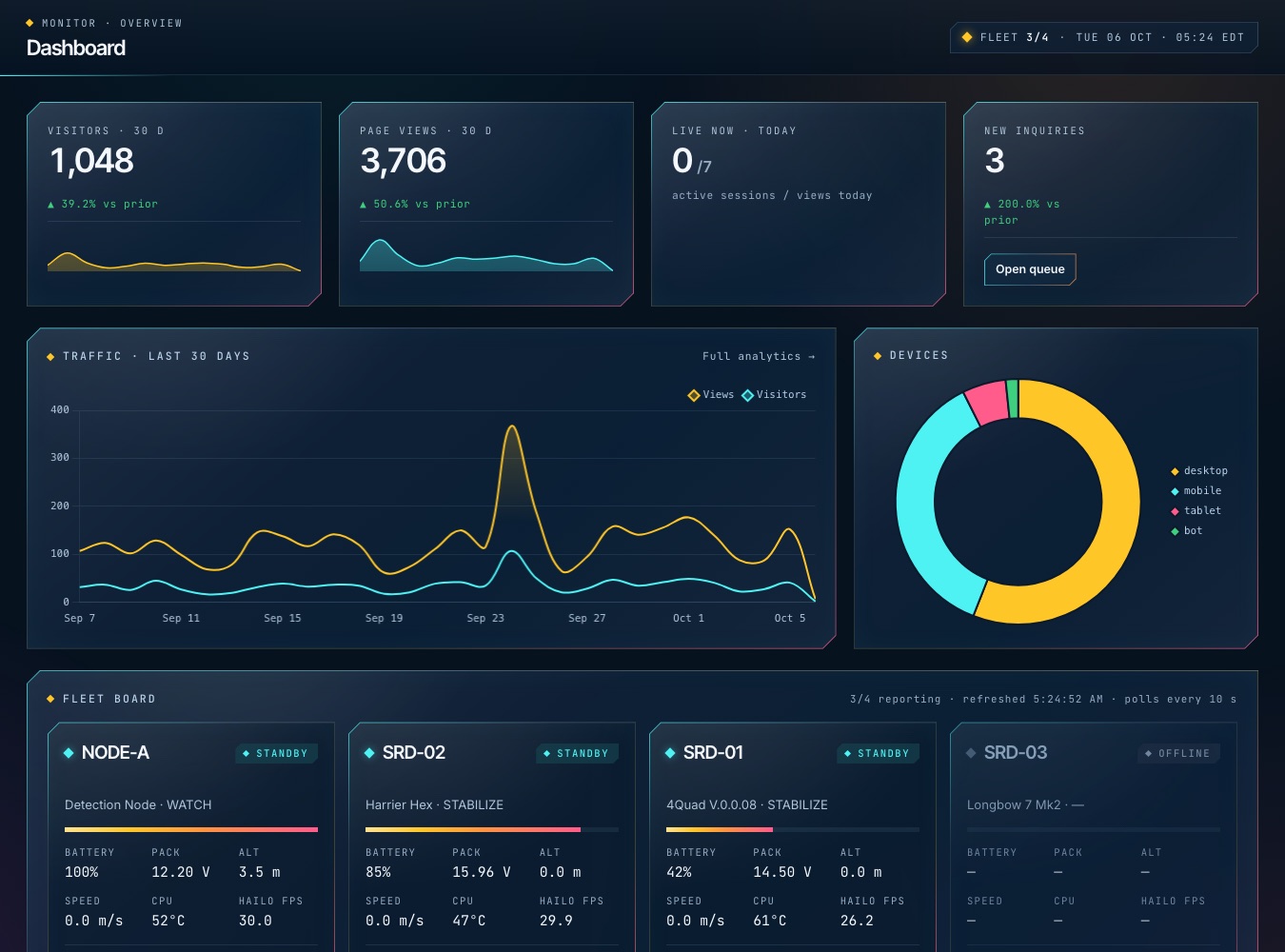
Operator console · shown with demonstration data
Battery, pack voltage, altitude, speed, CPU temperature and inference rate per airframe.
Class breakdown and hourly counts from every event an aircraft reports.
Six probes on a five-minute cycle with a 24-hour uptime timeline.
Every operator action recorded: who, what and when.
Capabilities, deployment model, telemetry, and exactly how the platform stays detection-only. We answer every serious inquiry directly.